An evidence worksheet for news-photo conclusions
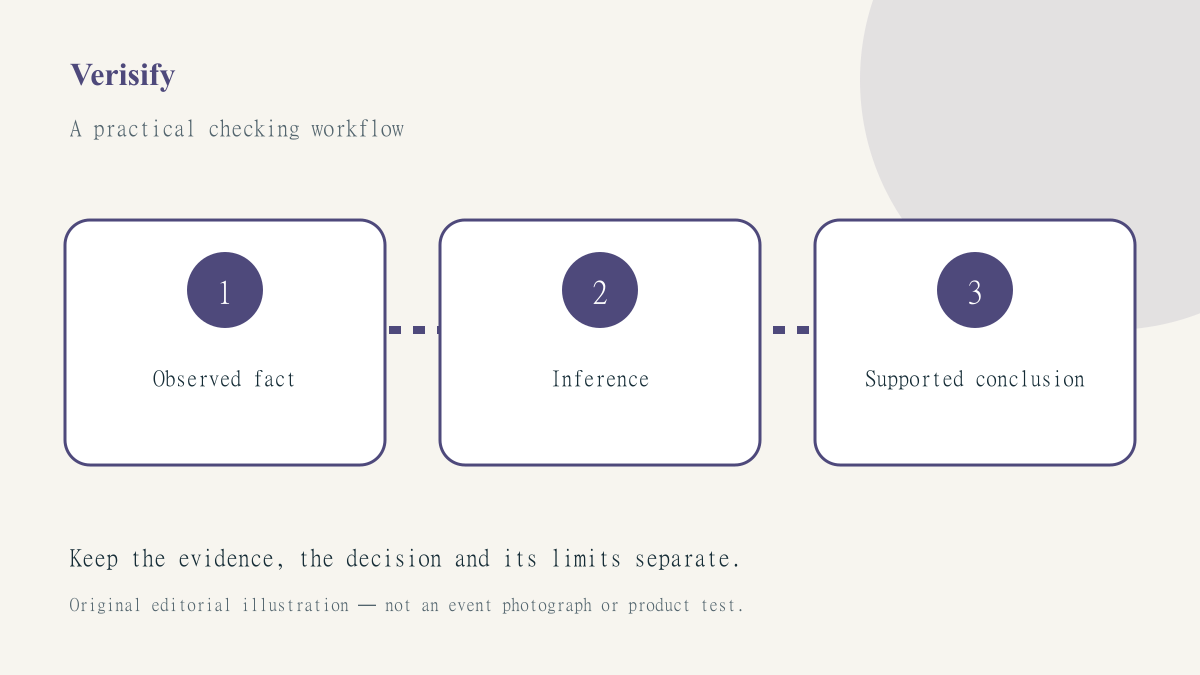
An image investigation can uncover several useful observations without establishing the dramatic conclusion people expect. A matching picture on an older page, a similar building or a partial credit may narrow the question while leaving date, location or event uncertain. A conclusion worksheet helps prevent those leads from being promoted into proof simply because the investigator has spent time collecting them.
The guide to checking news-photo context provides the source method. This edition focuses on the language of the final finding. It does not investigate a real current incident or claim that a particular circulating image is false.
Separate the three main questions
Write separate fields for what the image depicts, when the claimed event occurred and where the scene is said to be. Add the exact caption or surrounding claim being investigated. A genuine photograph can be associated with the wrong date or place, so a single true-or-false box often hides more than it explains.
Preserve the initial source page and an uncropped reference where you are authorised to keep it. Avoid exposing private information from a message or account as part of the public explanation. The purpose is to examine the claim, not to publish a history of everyone who happened to forward the image.
Write observations before interpretations
For each finding, describe exactly what you saw. An earlier page contains a visually matching crop is an observation. This proves when the photograph was taken is a much broader inference that the observation may not support. Keep the two statements in different fields so that a reviewer can assess the reasoning rather than inherit an unexplained verdict.
Where a result is only similar, identify the differences as well as the match. A sign, landmark or building shape can be a useful lead without settling a location. A search result’s date may describe a page or discovery record rather than the camera’s timestamp. Retaining those limits does not weaken an investigation; it makes its outcome more defensible.
Map the picture’s publication chain
Use the distinction between aggregation and original publishing to identify where captions and credits may have originated. A search card, aggregator thumbnail and later article can all point to one underlying asset. They should not be counted as separate independent records merely because they appear at different URLs.
The coverage comparison workflow is useful when captions conflict. Record which publisher attributes the picture to which photographer, agency or event. Follow the best available route to the fuller context, and note when that route is missing. Do not invent an origin to make the publication chain look complete.
Choose wording that matches the evidence
A finding may state that the same image appeared before the date claimed in a new post. Another may establish that an original caption identifies a different event. A third may remain unverified because the available pages lack a reliable date or location. These conclusions should not be collapsed into the same label.
Avoid calling an authentic but miscaptioned photograph fabricated unless there is evidence for that separate claim. Avoid attributing deliberate deception to a person merely because they shared old material. The conclusion should explain the supported discrepancy and link to the evidence, not use a stronger accusation because it makes a more compelling headline.
Preserve the route for correction
Use a final review row for each disputed detail: proposed conclusion, evidence URL, observed fact and remaining limitation. Read the conclusion without the surrounding research notes. If it sounds more certain than the evidence row permits, revise the public sentence rather than expecting readers to reconstruct qualifications hidden in the investigator’s private workspace.
Keep the observation time, source URLs and a short record of unresolved questions. If better evidence appears, a future reviewer should be able to identify which part of the earlier conclusion changes. Do not silently replace a qualified finding with a stronger one while retaining a misleading original checked date.
Before publication, ask another person to connect each sentence in the conclusion with the recorded evidence. If the sentence cannot be traced, narrow it or leave it out. Keep image reuse permission separate from factual accuracy; a verified picture is not automatically free to republish.
Use NewsBeagle to explore attributed reporting and our corrections route for concerns about these guides. A successful image investigation produces a clear account of what is known and unknown. It does not need a sensational verdict to justify the work.