How many independent news sources do you really have?
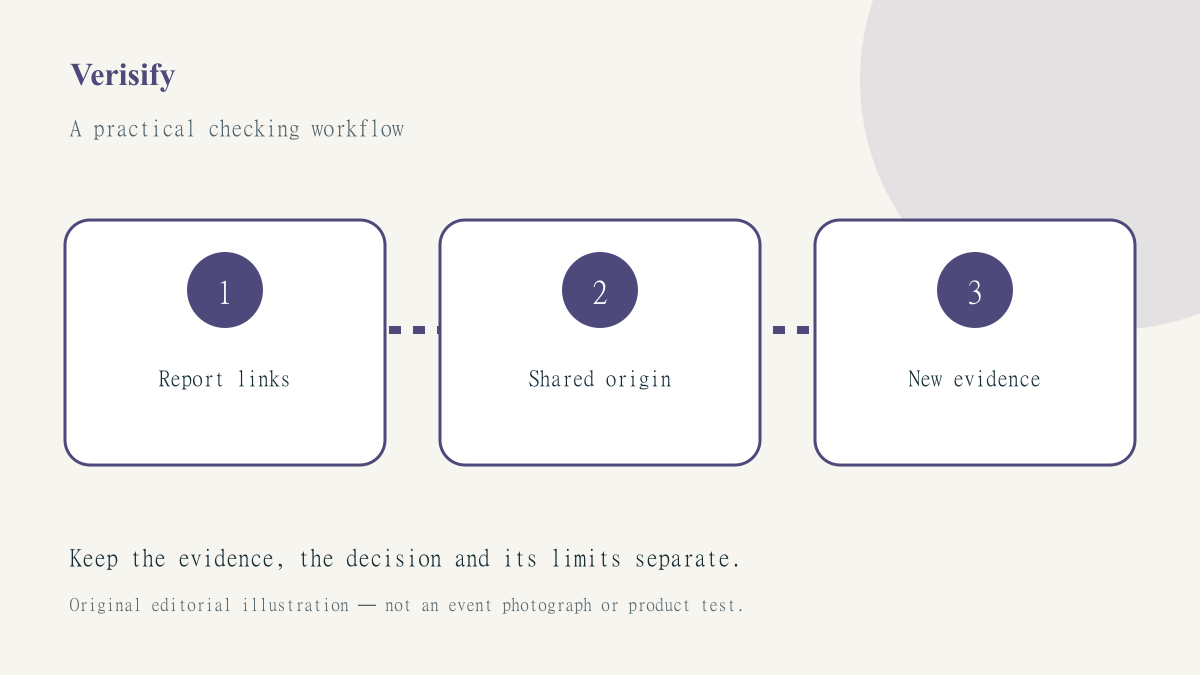
Three reports can agree because three journalists established the same fact independently, or because all three repeat one announcement. The number alone does not tell a reader which situation applies. Before describing a claim as multiply confirmed, trace the reporting chain and identify what new evidence each item contributes.
The explanation of news aggregation and original publishing provides the starting distinction. This Verisify guide offers a practical way to assess source independence. It does not rank publishers, certify a story or imply that secondary reporting is inherently unreliable.
Choose the factual claim to investigate
Write one testable sentence rather than investigating an entire topic at once. A hypothetical announcement might concern an opening date, a reported decision or a numerical result. Identify which part of the statement requires confirmation and what kind of evidence could establish it. A general impression that a story is widely discussed is not the same as evidence for its central fact.
Keep facts separate from interpretation. Several commentators may offer different explanations of one confirmed announcement without contributing additional confirmation of the announcement itself. Their analysis can still be useful, but it answers a different question. The source map should make that difference visible instead of treating every article as a vote in one undifferentiated count.
Follow attribution back to its origin
For each report, record the named source of the relevant claim. Look for an announcement, document, dataset, interview or direct observation. Follow available links and inspect the underlying material where appropriate. If attribution is missing or vague, note that limitation rather than supplying an origin the article does not identify.
The coverage-comparison guide helps structure this check. Draw arrows from each report to the evidence it relies on. If several arrows converge on the same statement, describe that shared source explicitly. This does not invalidate the reporting; it prevents a reader from mistaking distribution for additional independent evidence.
Identify what each report adds
Ask whether the publisher obtained a separate interview, inspected a document, tested a claim or simply rewrote the announcement. Record the addition alongside the report. A brief article with a relevant original observation may add more to the specific question than a long summary with an extensive background section.
Be careful with language such as independently verified. It describes work that should be identifiable, not an impression created by different headline wording. If you cannot establish how a source was checked, use a narrower description. For example, several reports attribute the statement to one organiser may be accurate where independently confirmed by several outlets is not supported.
Treat images as a separate evidence channel
A photograph repeated across several articles may come from one agency asset, earlier event or promotional package. The photo-context checklist can help trace that channel. Do not count each appearance of the same picture as another independent observation of the event.
Retain the image’s caption, credit and relevant date separately from the article’s publication time. A current article can use a historical illustration. Where the image does not directly support the factual claim under investigation, say so. An attractive visual can be useful context without increasing the number of independent confirmations.
Report the source map, not a false certainty score
A useful review question is whether removing one underlying announcement would remove support from most of the collected articles at once. If so, explain that shared dependency. The point is not to penalise publishers for covering the same announcement; it is to prevent the reader from mistaking several delivery routes for several separately established facts.
A practical conclusion might identify one primary statement, two summaries and one separate interview, then explain which question each supports. Another investigation might remain unresolved because all reports rely on unclear attribution. Both are useful outcomes when their limits are stated. Avoid inventing a numerical reliability score from a small collection of links.
Keep the source URLs and observation time so another person can reproduce the check. Note a meaningful review trigger, such as a promised document or an updated statement, rather than refreshing the conclusion automatically. A record of work actually performed is more valuable than a polished claim of certainty.
NewsBeagle can help locate attributed coverage, while the independence check still belongs to the reader or editor making the conclusion. Our editorial policy uses the same discipline: do not count a discovery link as reporting, and do not count repeated reporting as new evidence without tracing what it adds.