Check a VPN anonymity claim with an evidence card
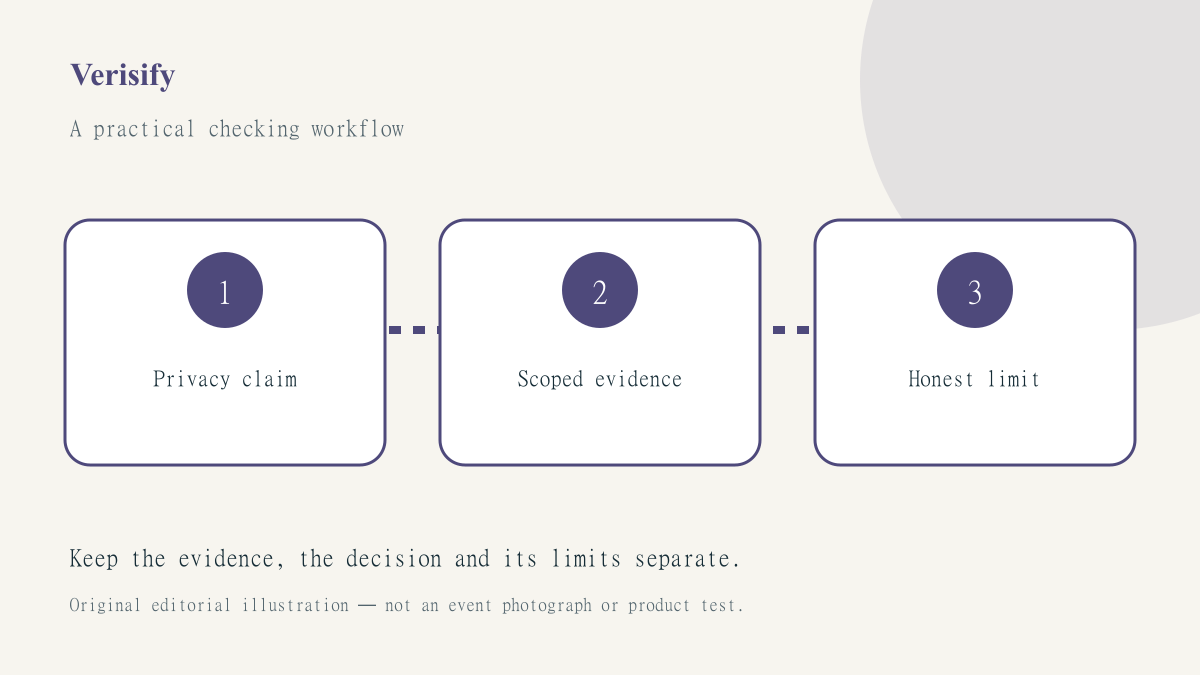
A claim that a VPN hides everything is difficult to verify because it does not say what everything includes. Network traffic, an account identity, a published profile and a message deliberately sent to another person are different parts of an online activity. Before judging the claim, define the specific information and observer concerned.
The explanation of what a VPN can and cannot hide provides the starting boundary. This guide develops a small evidence card for evaluating privacy language. It does not certify a product, report a penetration test or instruct readers to bypass an organisation’s access rules.
Turn the broad statement into smaller claims
Write the proposed statement in plain language, then identify its parts. Does it concern a supported connection path, a website’s view of a network address, an account’s own information or a recipient’s access to a message? If those parts are not separated, one successful-looking observation may be used to approve a much broader assurance.
Choose a realistic question that evidence could answer. A hypothetical user might ask whether a particular documented connection is active on their supported device. That question is narrower than whether the person is anonymous everywhere. A useful investigation can answer a bounded question without pretending to settle every privacy concern.
Record the source and scope of the evidence
Distinguish provider documentation, a user-interface indicator, a direct observation and an independent assessment. Record the platform, version and date where they matter. A feature advertised for one release should not silently become a claim about another. A screenshot can document an interface state while leaving many other behaviours untested.
Readers researching JungleVPN should use its current information for actual release and access details. This publication’s reference to an owned-network source does not constitute independent product verification. If a claim lacks suitable evidence, leave it unresolved rather than using the brand relationship as a substitute.
Test the inference, not just the visible result
An observation that a web page loaded supports a statement about that page load. An IP-location result can provide context without proving precise physical location, every application’s routing or universal anonymity. Write what the result actually establishes beside it so the evidence does not later become an unexplained green tick in a comparison or support note.
Ask what alternative explanations remain. If a service behaves differently after a network change, several parts of the workflow may have changed. Avoid attributing the outcome to the VPN alone without evidence. The card should distinguish observed sequence from demonstrated cause, especially where several settings were altered together.
Keep the surrounding checks in view
The public Wi-Fi routine keeps network identification, legitimate sign-in and destination checks separate. A connection tool does not make an impostor website genuine. Account information deliberately supplied to a service remains part of the privacy question even when a protected network path is in use.
For a failure, the troubleshooting workflow helps structure a bounded investigation. Do not bypass certificate warnings, expose credentials or disable protections simply to obtain a successful-looking result. A failed normal-use check is meaningful evidence; hiding the failure changes what can honestly be claimed.
Write a conclusion with explicit limits
Before approving a privacy statement, remove the product name and ask whether the evidence still supports the same sentence. This helps expose reasoning that depends on brand familiarity rather than the recorded observation. Reinsert the name only to identify the actual source or tested setup, not as an extra guarantee that fills the gaps in the evidence.
End with the specific claim evaluated, the evidence examined, the supported finding and what remains untested. Avoid absolute words such as completely or always unless the evidence truly supports their scope. A reader should be able to identify the device and activity to which the conclusion applies without guessing from an illustration.
Keep sensitive information out of the public record. Verification can describe a method and relevant result without publishing account names, private documents or complete access links. Where a formal assurance is required, an ordinary checklist should not be presented as a substitute for the appropriate qualified review.
Our claim-checking publication aims to make boundaries visible. A useful privacy explanation can recognise the value of a limited tool while rejecting an unsupported promise that it erases every trace of a person’s online activity. The strongest conclusion is the one another reader can trace back to evidence, including its limits.